
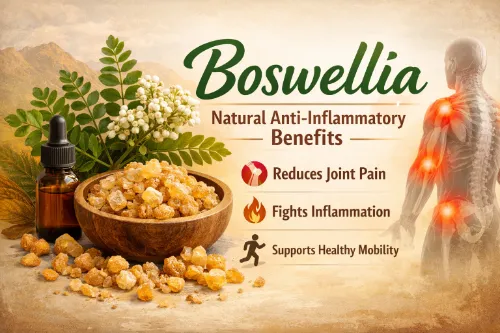
Boswellia (Indian frankincense) is a popular herbal anti‑inflammatory used mainly for joint and sometimes gut inflammation.
This guide explains how Boswellia works, what the research says about osteoarthritis and other conditions, how to take it safely, and how it can complement other anti‑inflammatory herbs like turmeric and ginger.
Introduction
Boswellia serrata is a tree native to India, and its resin has been used in traditional medicine for centuries to ease pain, stiffness, and inflammatory conditions. Modern extracts concentrate boswellic acids, the main active compounds believed to give Boswellia its anti‑inflammatory effects.
People often use Boswellia to help manage osteoarthritis, inflammatory joint pain, and some types of gut inflammation, usually as capsules or tablets of standardized extract. It is also frequently combined with turmeric and other herbs in joint support formulas for broader relief and cartilage protection.
Medical Disclaimer:
This information is for educational purposes only and does not replace medical advice, diagnosis, or treatment from your own healthcare provider.
What is Boswellia used for in inflammation?
Boswellia is mainly used to help reduce pain, stiffness, and swelling in osteoarthritis and other inflammatory joint conditions, and in some cases to support gut inflammation under medical supervision.
Is Boswellia good for joint pain?
Clinical trials and reviews suggest Boswellia can modestly improve joint pain, stiffness, and function in osteoarthritis compared with placebo, especially with consistent use over several weeks.
Can Boswellia help with whole‑body inflammation?
Boswellia’s effects are most studied in joints and some inflammatory gut conditions; it may help wider low‑grade inflammation, but should be considered a supportive therapy, not a stand‑alone cure.
How Boswellia Works as an Anti-Inflammatory
Boswellic acids (such as AKBA) are thought to act primarily by inhibiting 5‑lipoxygenase (5‑LOX), a key enzyme that converts arachidonic acid into leukotrienes—potent inflammatory molecules involved in joint and airway inflammation. By reducing leukotriene production, Boswellia may help lower inflammation, pain, and tissue damage in affected areas.
Some standardized Boswellia extracts (like 5‑Loxin) have also been shown in experimental and early clinical research to reduce inflammatory cytokines (such as TNF‑α, IL‑1β, and IL‑6), lower levels of cartilage‑degrading enzymes (MMP‑2 and MMP‑13), and protect the cartilage matrix. This suggests that Boswellia may help both with symptom relief and with slowing structural joint damage in osteoarthritis, though more high‑quality human data are still needed.
How does Boswellia reduce inflammation in the body?
Boswellic acids appear to directly inhibit 5‑LOX and reduce leukotriene production, and may also lower pro‑inflammatory cytokines and enzymes that break down cartilage.
Is Boswellia the same as taking an NSAID?
No. Boswellia works through different inflammatory pathways than NSAIDs like ibuprofen, generally with milder and slower effects. It should not replace prescribed anti‑inflammatory or disease‑modifying drugs without medical guidance.
Does Boswellia only help pain, or does it affect the underlying inflammation?
Studies suggest Boswellia can affect both pain and underlying inflammatory and cartilage‑degeneration pathways, but the size of the effect varies and more long‑term human data are needed.
Boswellia for Joint, Gut, and General Inflammation
Boswellia for Osteoarthritis and Joint Pain
Systematic reviews and randomized controlled trials report that Boswellia serrata extracts can modestly improve pain, stiffness, and function in people with osteoarthritis, particularly of the knee. Some trials show Boswellia performing better than placebo and, in certain cases, with similar short‑term pain improvements to low‑dose NSAIDs, but with a different side‑effect profile.
These benefits appear strongest when standardized extracts are used consistently for several weeks to months. Some products combine Boswellia with turmeric (Curcuma longa), and small studies suggest the combination may yield additive benefits for joint comfort.
External resources (Boswellia & arthritis):
Effectiveness of Boswellia for osteoarthritis – NIH/PMC: https://pmc.ncbi.nlm.nih.gov/articles/PMC7368679/
Cochrane – Oral herbal therapies for osteoarthritis (includes Boswellia): https://www.cochrane.org/evidence/CD002947_oral-herbal-therapies-treating-osteoarthritis
Is Boswellia good for knee arthritis?
Yes, moderate‑quality evidence suggests Boswellia serrata extracts can slightly improve pain and function in knee osteoarthritis for some people, especially with regular use.
How long does Boswellia take to work for joint pain?
Many studies report improvement within 4–8 weeks, with some people noticing benefits earlier. Consistent daily use is usually needed for full effect.
Boswellia for Gut and Other Inflammatory Conditions
Beyond joints, Boswellia has been studied in some inflammatory bowel conditions and other inflammatory disorders, often showing promising results in small or early‑phase trials. By reducing leukotriene‑driven inflammation, it may help support the gut lining and decrease inflammatory activity in certain cases.
However, inflammatory bowel disease (IBD) and other serious inflammatory disorders require specialist care, and Boswellia should only be used as a complementary therapy under medical supervision.
Can Boswellia help with gut inflammation?
Some studies suggest Boswellia may ease symptoms and inflammatory markers in certain gut conditions, but it should never replace standard treatment for IBD or other serious gastrointestinal diseases.
Is Boswellia useful for asthma or breathing issues?
Boswellic acids’ leukotriene‑modulating effects suggest potential in airway inflammation, but use for asthma or serious respiratory conditions should only occur with specialist guidance.
How to Take Boswellia for Inflammation
Forms of Boswellia
Boswellia is generally taken as:
- Capsules or tablets containing standardized Boswellia serrata extract
- Resin or powder in some traditional preparations
- Occasionally as topical creams, balms, or oils for localized joint or muscle discomfort
Most modern research uses standardized extracts that provide specific amounts or percentages of boswellic acids.
Quick Tip: When possible, choose Boswellia products that clearly state the extract type (for example, “Boswellia serrata extract”) and the percentage of total boswellic acids or AKBA on the label for more predictable effects.
Typical Dosage Ranges
Doses used in clinical trials vary, but often fall in the range of about 100–250 mg of standardized Boswellia extract taken two or three times daily, or around 300–500 mg once or twice daily depending on the formulation. Some branded extracts (like 5‑Loxin) use specific standardized doses studied in osteoarthritis.
There is no universally accepted “one dose fits all,” so it is important to follow the product label and ask your healthcare provider which dose is appropriate for you based on your condition and medications.
How should I take Boswellia for best effect?
Boswellia is usually taken with meals to improve tolerance and absorption, as a standardized extract used consistently for several weeks for joint or gut support.
Can I just use Boswellia resin instead of standardized extracts?
Traditional resin or powder can be used, but standardized extracts provide more consistent amounts of active boswellic acids and are the forms most often studied in clinical trials.
Safety, Side Effects & Interactions
Boswellia is generally well tolerated by many adults, but side effects can occur. Commonly reported issues include:
- Stomach pain or discomfort
- Acid reflux or heartburn
- Nausea or diarrhea
- Headache or general fatigue
- Skin rashes, especially with topical use
Boswellia may also stimulate blood flow in the uterus and pelvis and has been associated with increased menstrual flow and a potential risk of miscarriage. Because of this, it is not recommended during pregnancy, and caution is advised during breastfeeding.
Boswellia can interact with:
- NSAIDs (like ibuprofen, naproxen, aspirin) due to overlapping anti‑inflammatory effects and potential additive gastrointestinal risk
- Drugs metabolized by the liver (possible moderate interactions with some medications)
Is Boswellia safe to take every day?
Short‑term daily use appears reasonably safe for many adults when taken at standard doses, but long‑term safety data are limited. Regular monitoring and medical guidance are recommended for prolonged use.
Who should be cautious or avoid Boswellia supplements?
People who are pregnant (or trying to conceive), breastfeeding, have significant gastrointestinal disease, are on multiple anti‑inflammatory drugs, or take medications metabolized by the liver should discuss Boswellia with their clinician before use.
External resources (safety & interactions):
Healthline – Boswellia overview: https://www.healthline.com/health/boswellia
MedicalNewsToday – Boswellia uses & side effects: https://www.medicalnewstoday.com/articles/326599
MedicineNet – Boswellia warnings and side effects: https://www.medicinenet.com/boswellia/article.htm
Boswellia, Diet, and Other Anti-Inflammatory Herbs
Boswellia works best when combined with an anti‑inflammatory lifestyle, which includes:
- A diet rich in vegetables, fruits, whole grains, nuts, seeds, and healthy fats
- Snacks and meals that include other anti‑inflammatory herbs like turmeric and ginger
- Adequate sleep, stress management, and regular low‑impact physical activity
Boswellia is often combined with turmeric and sometimes green tea catechins in joint formulas. Some studies suggest that combining Boswellia with Curcuma longa (turmeric) can further improve joint pain and stiffness in osteoarthritis.
You can read more about how these herbs work individually here:
Turmeric
Ginger
For an overview of how multiple herbs can be used together:
Herbal anti‑inflammatory remedies
Can I combine Boswellia with turmeric or ginger?
Many joint formulas combine Boswellia with turmeric and sometimes ginger. This may offer complementary benefits but can increase the risk of interactions with medications, so medical advice is important.
Does Boswellia fit into an anti‑inflammatory diet?
Yes. Using Boswellia supplements alongside a whole‑food, anti‑inflammatory eating pattern and regular movement can provide a more comprehensive approach than any single intervention alone.
Frequently Asked Questions About Boswellia
Is Boswellia a strong natural anti‑inflammatory?
Boswellia is considered a potent natural leukotriene‑modulating anti‑inflammatory and has shown modest but meaningful benefits in osteoarthritis studies, especially for pain and stiffness.
How much Boswellia should I take daily?
Typical study doses range from about 100–250 mg of standardized extract two or three times daily, but you should follow product instructions and ask your healthcare provider what dose is suitable for you.
How long can I safely take Boswellia?
Short‑term studies (often up to 3–6 months) suggest good tolerability for many people. Long‑term use should be supervised by a healthcare professional due to limited long‑term safety data.
Does Boswellia thin the blood?
Boswellia is not a classic blood thinner, but it can interact with other anti‑inflammatory and possibly anticoagulant medications, so caution is advised if you are on blood thinners or multiple NSAIDs.
Can I take Boswellia together with my arthritis medications?
Possibly, but because of overlapping effects and potential interactions, you should only do this under the guidance of your rheumatologist or primary care clinician.
Conclusion
Boswellia serrata is a well‑known herbal anti‑inflammatory that may help reduce pain, stiffness, and inflammation in osteoarthritis and some other inflammatory conditions, particularly when used as a standardized extract over several weeks. Its main active compounds, boswellic acids, act primarily by inhibiting leukotriene‑driven inflammation and may also protect cartilage.
Because Boswellia can cause digestive side effects, may influence menstrual flow, and can interact with certain medications, it is important to discuss its use with your healthcare provider—especially if you are pregnant, have chronic illnesses, or take prescription drugs. For a broader view of how Boswellia fits into a complete herbal strategy for inflammation, explore:
Herbal anti‑inflammatory remedies
Disclaimer:
This information is for educational purposes only and does not replace medical advice, diagnosis, or treatment from your own healthcare provider.
Written by: Eden Grace Ramos-Arsenio, RN
Sources: Peer‑reviewed clinical trials and reviews on Boswellia in osteoarthritis and inflammatory conditions; National and international pharmacology and rheumatology literature on boswellic acids, 5‑LOX inhibition, safety, and side effects.