
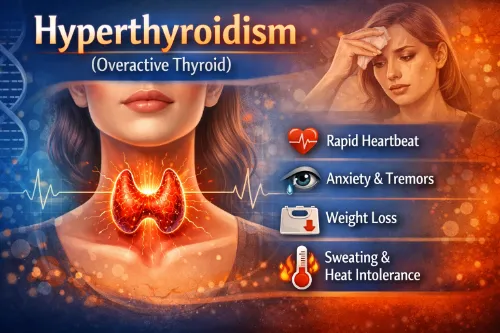
Hyperthyroidism, or overactive thyroid, happens when your thyroid gland makes and releases more thyroid hormone than your body needs. This speeds up many body functions and can cause symptoms like weight loss, rapid heartbeat, tremors, heat intolerance, and anxiety.
For a structured overview, you can also see our main page Hyperthyroidism (Overactive Thyroid) and patient information from Cleveland Clinic, NIDDK/NIH, Mayo Clinic, and the American Thyroid Association.
What Is Hyperthyroidism?
In hyperthyroidism, the thyroid gland produces too much thyroxine (T4) and triiodothyronine (T3). Excess hormone in the bloodstream makes your metabolism run faster than normal, which stresses the heart, nervous system, muscles, and other organs.
Doctors sometimes use the term thyrotoxicosis to describe the overall effects of having too much thyroid hormone in the body, regardless of the cause. Hyperthyroidism is the most common cause of thyrotoxicosis but not the only one.
Common Symptoms of Hyperthyroidism
Symptoms often develop gradually but can sometimes appear quickly. Many are related to a “revved up” metabolism and overactive sympathetic nervous system.
Typical symptoms include:
- Nervousness, anxiety, and irritability – feeling “on edge” or easily upset.
- Fast or irregular heartbeat (palpitations) – you may feel your heart racing or pounding.
- Weight loss despite normal or increased appetite.
- Heat intolerance and sweating – feeling unusually hot, sweaty, or flushed.
- Tremors – shaky hands or fine trembling in fingers.
- Difficulty sleeping (insomnia) and restlessness.
- Muscle weakness – especially in the upper arms and thighs.
- Frequent bowel movements or diarrhea.
- Menstrual changes in women, such as lighter, less frequent periods.
- Eye symptoms in Graves’ disease, such as gritty feeling, light sensitivity, bulging eyes, or double vision.
Older adults may have fewer classic symptoms and present mainly with weight loss, fatigue, or heart rhythm problems like atrial fibrillation.
What Happens in the Body?
When the thyroid is overactive, it releases excess T4 and T3 into the bloodstream. The pituitary gland senses the high level of hormone and lowers thyroid‑stimulating hormone (TSH) to try to slow the thyroid down.
Typical blood test pattern:
- TSH is low or suppressed.
- Free T4 and/or T3 are high (overt hyperthyroidism) or at the high end of normal.
High thyroid hormone levels increase the number of beta‑adrenergic receptors and Na⁺/K⁺‑ATPase pumps, which boosts heart rate, heat production, and overall energy use. In some people, TSH is low but T4 and T3 are still in the reference range – this is called subclinical hyperthyroidism and may still carry risks, especially for the heart and bones.
Most Common Causes of Hyperthyroidism
Hyperthyroidism can result from several different conditions. Identifying the cause is important because it guides treatment.
1. Graves’ Disease
Graves’ disease is the most common cause of hyperthyroidism in many countries. It is an autoimmune condition in which the immune system makes antibodies that stimulate the thyroid to grow and produce too much hormone.
Features may include:
- Diffuse (smooth) enlargement of the thyroid (goiter).
- Eye problems (Graves’ ophthalmopathy) – such as bulging eyes, eye pain, gritty sensation, or double vision.
- Skin changes over the shins (pretibial myxedema) in a minority of patients.
Graves’ disease often requires long‑term follow‑up, and treatment options include antithyroid drugs, radioactive iodine, or surgery.
2. Toxic Nodular Disease (Toxic Adenoma and Toxic Multinodular Goiter)
In toxic nodular disease, one or more nodules in the thyroid become overactive and produce hormone without normal TSH control.
- Toxic adenoma – a single “hot” nodule that autonomously produces hormone.
- Toxic multinodular goiter – several overactive nodules within a larger, often long‑standing goiter.
This type of hyperthyroidism is more common in older adults and in areas with long‑standing goiter or previous iodine deficiency.
3. Thyroiditis (Inflammatory Causes)
Various forms of thyroiditis can cause a temporary release of stored hormones, leading to short‑term hyperthyroidism.
Examples:
- Subacute (de Quervain’s) thyroiditis – often painful, with neck tenderness and fever; thought to be triggered by viral infections.
- Painless/silent thyroiditis – often autoimmune, may occur after pregnancy (postpartum thyroiditis).
- Drug‑induced thyroiditis – from medications such as amiodarone, interferon, or immune checkpoint inhibitors.
These conditions often progress from hyperthyroidism to hypothyroidism, then back to normal over months, though some people are left with permanent thyroid underactivity.
4. Other Causes
Less common causes include:
- Excess thyroid hormone intake – taking too much levothyroxine or other thyroid hormones (intentional or accidental).
- TSH‑secreting pituitary tumors – rare tumors that produce too much TSH and drive the thyroid to overproduce hormone.
- Very high hCG levels in certain pregnancy‑related tumors, which can mildly stimulate the thyroid.
How Hyperthyroidism Is Diagnosed
Diagnosis combines symptoms, physical examination, blood tests, and sometimes imaging.
Key tests:
- TSH – typically low or undetectable in overt hyperthyroidism.
- Free T4 and free T3 – usually raised; some patients have “T3‑predominant” hyperthyroidism where T3 is high but T4 is normal.
- Thyroid antibodies – such as TSH‑receptor antibodies (TRAb) to confirm Graves’ disease.
Imaging may include:
- Thyroid uptake scan – shows how much radioactive tracer the thyroid absorbs and whether uptake is diffuse (Graves’), focal (toxic nodule), or low (thyroiditis).
- Thyroid ultrasound – looks for nodules, goiter, or structural changes, and helps guide further testing if needed.
Your provider will also ask about medications, supplements, and family history to identify possible triggers or risk factors.
Treatment and Long‑Term Management
Hyperthyroidism is usually treatable, but the best approach depends on the cause, severity, age, other health problems, and your preferences.
Main options include:
Antithyroid Medications
Drugs such as methimazole (or propylthiouracil in specific situations) reduce the thyroid’s ability to make new hormone.
- Often used as first‑line treatment in Graves’ disease and sometimes before surgery or radioactive iodine.
- Doses are adjusted based on thyroid function tests every few weeks to months until stable.
- Side effects can include rash, joint pain, and rarely serious liver or bone‑marrow problems, so urgent review is needed if you develop fever, sore throat, or jaundice.
Radioactive Iodine Therapy
Radioactive iodine (RAI) is taken as a capsule or liquid and is absorbed by overactive thyroid cells, gradually destroying them.
- Commonly used for Graves’ disease and toxic nodular goiter.
- Not usually given in pregnancy or while breastfeeding.
- Many people develop hypothyroidism afterwards and then take lifelong levothyroxine, which is generally easier to manage than persistent hyperthyroidism.
Surgery (Thyroidectomy)
Surgery removes part or all of the thyroid gland.
It may be recommended if:
- You have a large goiter causing compressive symptoms.
- Nodules or imaging findings raise concern for cancer.
- You cannot tolerate or do not respond to medication, or do not wish to have RAI.
After surgery, most people need lifelong thyroid hormone replacement.
Symptom Control (Beta‑Blockers)
Medicines such as propranolol or other beta‑blockers are often used to quickly improve symptoms like tremor, palpitations, and anxiety while the main treatment takes effect.
Possible Complications if Untreated
If hyperthyroidism is not treated or is poorly controlled, it can lead to serious complications.
These may include:
- Heart problems – atrial fibrillation, rapid heart rate, high blood pressure, and heart failure in severe or long‑standing cases.
- Bone loss (osteoporosis) – long‑term excess thyroid hormone accelerates bone turnover and increases fracture risk, especially in older adults and postmenopausal women.
- Eye disease in Graves’ – eye pain, double vision, or vision loss if inflammation is severe and untreated.
- Thyroid storm (thyrotoxic crisis) – a rare, life‑threatening emergency with very high thyroid hormone levels, high fever, severe agitation, confusion, and heart failure; it needs immediate hospital care.
Early diagnosis and appropriate management greatly reduce these risks.
Living Well with Hyperthyroidism
With the right treatment plan and follow‑up, most people with hyperthyroidism can return to normal daily activities.
Key points for long‑term management:
- Work with an endocrinologist or experienced primary care provider to choose the best treatment for your situation.
- Keep regular appointments and blood tests to monitor thyroid levels and adjust treatment.
- Tell your provider if you are pregnant, planning pregnancy, or breastfeeding, as treatment options and targets may change.
- If you have Graves’ eye disease, you may also need an ophthalmologist experienced in thyroid eye problems.
Good patient summaries are available from NIDDK, Mayo Clinic, Cleveland Clinic, and NHS.
Pro Tip for Daily Living with Hyperthyroidism
- If you’re starting antithyroid medication, ask your provider exactly what symptoms mean “call urgently” (for example, fever and sore throat) and keep this written down or saved in your phone.
- Until your levels are controlled, avoid excess caffeine and stimulants, which can make palpitations, tremors, and anxiety feel worse.
- Keep a simple record of your heart rate (for example, morning and evening) and how you feel; share this with your doctor at follow‑up visits.
- If you smoke and have Graves’ disease, ask for help to stop smoking, as smoking can worsen eye complications.
- Before any surgery or major illness, make sure the medical team knows you have hyperthyroidism (or that you are on antithyroid treatment), as this can affect anesthesia and monitoring plans.
Frequently Asked Questions
1. Can what I eat affect my hyperthyroidism?
Diet cannot cure hyperthyroidism, but very high iodine intake (for example from certain supplements, seaweed/kelp, or iodinated contrast) can worsen some forms like Graves’ disease. Many clinicians suggest a balanced diet with adequate calcium, vitamin D, protein, and avoiding excess iodine unless your specialist advises otherwise.
2. Is exercise safe if I have hyperthyroidism?
Mild to moderate activity is usually fine once your heart rate and blood pressure are reasonably controlled, but intense exercise is often limited until treatment has begun to stabilize thyroid levels and heart rhythm. Your clinician may individualize advice based on symptoms like palpitations, shortness of breath, or atrial fibrillation.
3. Can hyperthyroidism affect my fertility or ability to get pregnant?
Yes, uncontrolled hyperthyroidism can disturb menstrual cycles, interfere with ovulation, and lower chances of conception, though many people still can become pregnant. Treating the overactive thyroid and reaching a stable euthyroid state often improves fertility and pregnancy outcomes.
4. Is hyperthyroidism always a lifelong condition?
Some causes (like painless or subacute thyroiditis) can be temporary and resolve over months, while autoimmune Graves’ disease and toxic nodular disease tend to be long‑term and may require definitive treatment. Even after “definitive” therapy (RAI or surgery), follow‑up is lifelong because many people then need ongoing thyroid hormone replacement.
5. Are there triggers that can make my hyperthyroidism flare up?
Infections, major stress, surgery, stopping antithyroid drugs abruptly, or exposure to high iodine (contrast dyes, certain heart drugs like amiodarone) can exacerbate hyperthyroidism or precipitate thyroid storm in susceptible patients. People with known disease are usually advised to tell any treating team about their thyroid status before scans or procedures.
6. How often will I need blood tests?
At the start of treatment, thyroid function tests (TSH, free T4 and sometimes T3) are usually checked every 4–6 weeks to adjust medication. Once levels are stable, intervals often extend to every 3–12 months depending on the cause of hyperthyroidism and whether you are on replacement or antithyroid drugs.
7. Can I take over‑the‑counter supplements if I have hyperthyroidism?
Many “thyroid support” or multivitamin products contain iodine, biotin, or herbal stimulants that can either worsen hyperthyroidism or interfere with lab test accuracy. It is important to show all supplements to your clinician and avoid starting new ones without checking first.
8. What should I know about hyperthyroidism and pregnancy?
Pregnancy changes thyroid hormone needs, and both under‑ and over‑treatment carry risks for mother and baby, so doses and targets may be adjusted and monitoring is more frequent. Certain antithyroid drugs and radioactive iodine are avoided or timed carefully in pregnancy, so pre‑conception planning with an endocrinologist is recommended.
9. Can stress make my hyperthyroidism worse?
Stress does not directly cause Graves’ disease or toxic nodular goiter, but chronic stress hormones can affect immune and endocrine function and may make symptoms like palpitations, anxiety, and sleep problems more noticeable. Stress‑management strategies (sleep hygiene, relaxation techniques, counseling) are often suggested as part of overall care.
10. Are there long‑term eye or skin issues I should watch for beyond the acute phase?
In Graves’ disease, eye changes can progress or flare even after thyroid levels are controlled, particularly in smokers, and may require separate ophthalmologic treatments. Rarely, skin thickening (pretibial myxedema) can persist and may be treated with topical or other therapies under specialist guidance.
Disclaimer: This information is for educational purposes only and does not replace medical advice, diagnosis, or treatment from your own healthcare provider.
Written by: Eden Grace Ramos-Arsenio, RN
Sources: National Institute of Diabetes and Digestive and Kidney Diseases (NIDDK/NIH); Cleveland Clinic; Mayo Clinic; NHS; American Thyroid Association (ATA); Patient.info; AMBOSS; American Academy of Family Physicians (AAFP); peer‑reviewed medical and nursing journals.