
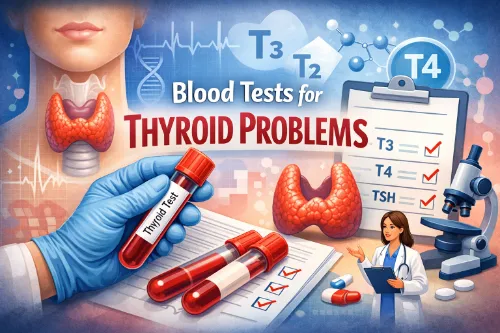
Blood tests are the core tools doctors use to assess how well your thyroid is working. They measure hormone levels in your blood and help show whether your thyroid is underactive, overactive, or functioning normally.
You can read your main guide at Blood Tests and patient information from NIDDK, Mayo Clinic, NHS, Cleveland Clinic, and the American Thyroid Association (ATA).
Why Thyroid Blood Tests Matter
Thyroid blood tests:
- Help confirm or rule out hypothyroidism and hyperthyroidism
- Help distinguish between different underlying causes (for example, autoimmune vs. medication‑related)
- Guide decisions about treatment (starting, adjusting, or stopping medicine)
- Allow long‑term monitoring of people living with thyroid conditions
Most people need only a few key tests, repeated as needed over time, as outlined in endocrine society and primary‑care guidelines.
TSH (Thyroid‑Stimulating Hormone)
TSH is made by your pituitary gland (in the brain) and “tells” your thyroid how hard to work.NIDDK – Hypothyroidism
- When thyroid hormone is too low, TSH usually goes up to push the thyroid harder.
- When thyroid hormone is too high, TSH usually goes down (or is suppressed) to tell the thyroid to slow down.
Typical patterns (described by ATA and Mayo Clinic):
- High TSH + low free T4 → Overt hypothyroidism (underactive thyroid)
- Slightly high TSH + normal free T4 → Subclinical hypothyroidism
- Low or undetectable TSH + high free T4 and/or T3 → Overt hyperthyroidism (overactive thyroid)
- Low TSH + normal free T4/T3 → Subclinical hyperthyroidism
TSH is often the first test ordered because it is very sensitive to thyroid changes.ATA – Thyroid Function Tests
Free T4 (Free Thyroxine)
Free T4 measures the active form of thyroxine, the main hormone produced by the thyroid.
- Low free T4 suggests the body does not have enough thyroid hormone (especially if TSH is high).
- High free T4 suggests too much thyroid hormone (especially if TSH is low).
Used together with TSH, free T4 helps confirm:
- Hypothyroidism – high TSH, low free T4
- Hyperthyroidism – low TSH, high free T4
You can see how these results relate to everyday symptoms in:
External references:
Mayo Clinic – Hypothyroidism: Diagnosis and treatment
NHS – Underactive thyroid: Diagnosis
Free T3 (Free Triiodothyronine)
Free T3 measures the active form of triiodothyronine, a more potent thyroid hormone made by the thyroid and by conversion of T4 in the body.NIDDK – Hyperthyroidism
Doctors may order free T3 when:
- Hyperthyroidism is suspected, especially if TSH is low but free T4 is still in the normal range.
- They suspect T3‑predominant hyperthyroidism, where T3 is high before T4 rises.
Free T3 is less often needed for diagnosing hypothyroidism but may be checked in complex cases.Cleveland Clinic – Thyroid Function Tests
Thyroid Antibody Tests
Antibody tests help detect autoimmune thyroid disease, where the immune system attacks or overstimulates the thyroid.ATA – Thyroid Function Tests
Common antibody tests:
- TPO antibodies (TPOAb) – often elevated in Hashimoto’s thyroiditis and sometimes in Graves’ disease
- Thyroglobulin antibodies (TgAb) – may also appear in autoimmune thyroid conditions
- TSH‑receptor antibodies (TRAb, including TSI) – typically elevated in Graves’ disease, helping confirm that diagnosis
These tests are especially useful when:
- The cause of thyroid dysfunction is unclear
- There is a strong personal or family history of autoimmune disease
- A doctor wants to distinguish autoimmune causes from other reasons for thyroid dysfunction
Related overview on your site:
External references:
NIDDK – Hashimoto’s disease
NIDDK – Graves’ disease
Other Blood Tests Sometimes Used
Depending on your situation, your doctor may order additional tests:ATA – Thyroid Function Tests
- Thyroglobulin (Tg) – mainly used in thyroid cancer follow‑up after surgery or radioactive iodine, not for routine diagnosis.
- Calcitonin – sometimes checked when medullary thyroid carcinoma is suspected.
- Cholesterol and lipids – can be raised in hypothyroidism and may improve once thyroid levels are corrected.
- Liver and muscle enzymes – to check for other conditions or side effects of treatment.
These tests are usually tailored to specific clinical questions, not needed for everyone.
How Blood Tests Fit into the Diagnostic Process
Blood tests are interpreted alongside:
- Symptoms and physical examination – see How Thyroid Problems Are Diagnosed.
- Imaging, such as ultrasound, if there are nodules or goiter – see Imaging Tests.
- Biopsy, when a nodule looks suspicious – covered in Thyroid Nodules & Goiter.
Your provider looks at all of this together before confirming a diagnosis and discussing management. General pathways are described in NHS thyroid disease diagnosis, NIDDK, and Endocrine Society.
Blood Tests for Monitoring Treatment
Once a thyroid condition is diagnosed, blood tests are used to fine‑tune and monitor treatment.
Examples:
- Hypothyroidism on levothyroxine
- TSH (and sometimes free T4) are checked about 6–8 weeks after a dose change, then every 6–12 months when stable.Mayo Clinic
- The goal is a TSH within your provider’s target range and relief of symptoms.
- Hyperthyroidism on antithyroid drugs
- TSH, free T4, and sometimes free T3 are checked more frequently at first (every few weeks), then less often once levels stabilise.NIDDK – Hyperthyroidism
- Long‑term patterns help decide whether to continue medicine, switch to radioactive iodine, or consider surgery.
More on ongoing care:
Pro Tip for Daily Living
- Ask your provider for a copy of your thyroid lab results (TSH, free T4, free T3, antibodies) and keep them in a simple log or note on your phone – a practice encouraged by many thyroid patient organisations such as Thyroid UK.
- Try to do repeat blood tests at roughly the same time of day and on a stable medication schedule (for example, always taking levothyroxine first thing in the morning, on an empty stomach) so results are easier to compare.Mayo Clinic
- If something in your results is unclear, ask:
- “What pattern do you see in my TSH and free T4?”
- “What is our target range?”
- “When should we test again?”
Disclaimer: This information is for educational purposes only and does not replace medical advice, diagnosis, or treatment from your own healthcare provider.
Written by: Eden Grace Ramos-Arsenio, RN
Sources: National Institute of Diabetes and Digestive and Kidney Diseases (NIDDK/NIH); Mayo Clinic; NHS; American Thyroid Association (ATA); Cleveland Clinic; Endocrine Society; Thyroid UK; MedlinePlus; peer‑reviewed medical and nursing journals.