
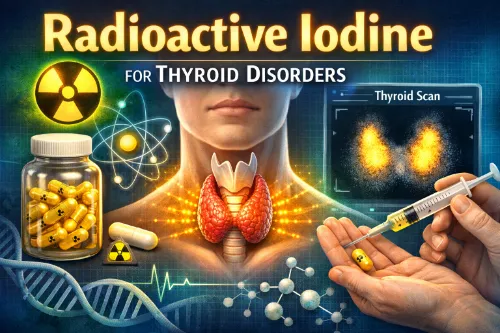
Radioactive iodine (RAI) is a targeted treatment that uses a small, controlled dose of radiation to destroy overactive or abnormal thyroid tissue. It is most often used for overactive thyroid (hyperthyroidism) and some types of thyroid cancer.
You can read your main guide at Radioactive Iodine, and patient overviews from NIDDK, Mayo Clinic, NHS, Cleveland Clinic, and the American Thyroid Association (ATA).
When Is Radioactive Iodine Used?
Radioactive iodine is commonly recommended for:
- Graves’ disease that is recurrent, difficult to control with tablets, or when long‑term medication is not desired.
- Toxic (overactive) nodules and toxic multinodular goiter.
- Selected cases of thyroid cancer (mainly papillary and follicular types) after surgery, to destroy remaining thyroid tissue or microscopic cancer cells.
It may not be suitable for:
- Pregnant or breastfeeding people (contra‑indicated).
- Some people with significant Graves’ eye disease (orbitopathy), unless co‑managed with a specialist.
- Certain children or high‑risk groups, where other options may be preferred.
For context, see:
- Hyperthyroidism (Overactive Thyroid)
- Thyroid Cancer (Brief Overview)
- Treatment Options for Thyroid Disorders
How Radioactive Iodine Works
The thyroid gland naturally absorbs iodine to make thyroid hormones. Radioactive iodine treatment uses this property to deliver radiation directly to thyroid cells:
- You receive a dose of radioactive iodine (often I‑131) as a capsule or liquid.
- The iodine is absorbed into your bloodstream and taken up by thyroid tissue.
- The radiation travels only a short distance and gradually damages or destroys the targeted thyroid cells over weeks to months.
Because most other tissues take up little iodine, the effect is focused mainly on the thyroid and, in cancer treatment, any thyroid cancer cells that still absorb iodine.
More background:
- NIDDK – Hyperthyroidism: https://www.niddk.nih.gov/health-information/endocrine-diseases/hyperthyroidism
- ATA – Radioactive Iodine: https://www.thyroid.org/radioactive-iodine/
Radioactive Iodine for Hyperthyroidism
Before the Treatment
Your team may:
- Review blood tests (TSH, free T4, free T3), diagnosis, and imaging.
- Adjust or briefly stop antithyroid tablets so the iodine is taken up effectively (timing depends on local protocol).
- Ask you to avoid iodine‑rich foods and supplements (for example, seaweed, kelp tablets, certain contrast dyes) for a short period.
- Check for pregnancy in anyone who could be pregnant; treatment is postponed if positive.
See:
During the Treatment
- You usually receive a single dose in hospital or a specialist clinic.
- The appointment is brief: you swallow the capsule or liquid and then go home or to a designated area, depending on local rules.
- You do not feel the radiation as it is given; the dose itself is painless.
After the Treatment
In the following weeks to months:
- Thyroid hormone levels gradually fall as overactive cells are damaged.
- Symptoms of hyperthyroidism (palpitations, tremor, heat intolerance, anxiety) usually improve progressively.
- Many people eventually develop hypothyroidism and need lifelong levothyroxine.
You will need:
- Regular blood tests (TSH, free T4 ± free T3).
- Follow‑up to start or adjust levothyroxine and manage any remaining symptoms.
Helpful patient resources:
- NHS – Overactive thyroid: treatment: https://www.nhs.uk/conditions/overactive-thyroid-hyperthyroidism/treatment/
- Cleveland Clinic – Radioactive Iodine Therapy: https://my.clevelandclinic.org/health/treatments/15455-radioactive-iodine-therapy
Radioactive Iodine for Thyroid Cancer
In some types of thyroid cancer, radioactive iodine is used after surgery to:
- Destroy remaining normal thyroid tissue (remnant ablation).
- Treat or detect residual or microscopic cancer cells that absorb iodine.
Typical steps:
- Surgery (often total thyroidectomy) is done first.
- TSH is temporarily raised (either by stopping hormone tablets or using injectable recombinant TSH) so remaining thyroid cells take up more iodine.
- You then receive a calculated dose of radioactive iodine.
After treatment:
- You take levothyroxine, usually at a dose that keeps TSH a bit lower than normal to reduce recurrence risk.
- Follow‑up includes blood tests (for example, thyroglobulin in appropriate cancers) and imaging.
More detail:
- Thyroid Cancer (Brief Overview)
- NCI – Thyroid Cancer Treatment (PDQ): https://www.cancer.gov/types/thyroid/patient/thyroid-treatment-pdq
Safety, Precautions, and Side Effects
Common Short‑Term Effects
Some people experience:
- Mild neck discomfort or tenderness.
- Temporary sore throat or feeling of swelling.
- Dry mouth or altered taste.
- Transient worsening of hyperthyroid symptoms if hormone levels fluctuate.
These effects are usually mild and settle within days to weeks.
Long‑Term Effects
- Most people treated for hyperthyroidism with RAI become hypothyroid and need lifelong levothyroxine.
- For cancer treatment, repeated or higher doses can slightly increase risks of salivary gland problems (dry mouth, dental issues) or tear gland changes in some people.
- Your specialist will discuss your individual risk–benefit balance.
External references:
- Mayo Clinic – Radioactive iodine therapy: https://www.mayoclinic.org/tests-procedures/radioactive-iodine-therapy/about/pac-20384898
- ATA – Radioactive Iodine: https://www.thyroid.org/radioactive-iodine/
Radiation Safety and Home Precautions
For a short time after treatment, a small amount of radiation leaves your body in urine, saliva, and sweat. To protect people around you, especially children and pregnant people, you will receive written safety instructions, which may include:
- Limiting close contact (for example, avoid prolonged cuddles and keep some distance when sitting together) for a set number of days.
- Sleeping in a separate bed for a period advised by your team.
- Using your own towels, toothbrush, and eating utensils where possible.
- Flushing the toilet twice and washing hands thoroughly after use.
- Avoiding pregnancy for a specific period (often 6–12 months after treatment; your team will give exact guidance).
These instructions vary by dose, indication (hyperthyroidism vs cancer), and local regulations, so always follow the written advice from your own hospital or clinic.
Good overviews:
- NHS – Radioactive iodine treatment: https://www.nhs.uk/conditions/thyroid-cancer/treatment/#radioactive-iodine-treatment
- Cancer Research UK – Radioactive iodine treatment: https://www.cancerresearchuk.org/about-cancer/thyroid-cancer/treatment/radioactive-iodine
Who Should Not Have Radioactive Iodine?
Radioactive iodine is generally not used in:
- Pregnancy – it can damage the fetal thyroid gland.
- Breastfeeding – iodine concentrates in breast milk; breastfeeding must be stopped well before treatment.
- Some people with active or severe Graves’ eye disease, unless additional protective measures (for example, steroids) are planned.
- Specific paediatric or high‑risk cases where alternatives are safer.
If RAI is not suitable, options may include antithyroid drugs or surgery. See:
Living After Radioactive Iodine
Most people return to normal routines quickly after the short safety period.
Long‑term care points:
- Attend scheduled blood tests to keep your hormone levels in the target range.
- Take levothyroxine exactly as prescribed if you are hypothyroid.
- Report persistent or new symptoms (for example, fatigue, weight change, palpitations, neck swelling, or eye changes).
- Ask how RAI fits into your overall follow‑up plan, particularly after cancer treatment.
For broader support:
- Living with a Thyroid Condition
- Thyroid UK – Patient information: https://thyroiduk.org/about-thyroid-conditions/
Questions to Ask Your Healthcare Provider
- “Why are you recommending radioactive iodine for me instead of (or as well as) tablets or surgery?”
- “What are the main benefits and risks in my situation?”
- “What precautions do I need to follow at home, and for how long?”
- “How likely is it that I will need thyroid hormone replacement afterwards?”
- “How often will my levels be checked, and who will oversee my long‑term follow‑up?”
Disclaimer: This information is for educational purposes only and does not replace medical advice, diagnosis, or treatment from your own healthcare provider.
Written by: Eden Grace Ramos-Arsenio, RN
Sources: National Institute of Diabetes and Digestive and Kidney Diseases (NIDDK/NIH); Mayo Clinic; NHS; American Thyroid Association (ATA); Cleveland Clinic; Endocrine Society; Thyroid UK; MedlinePlus; peer‑reviewed medical and nursing journals.