
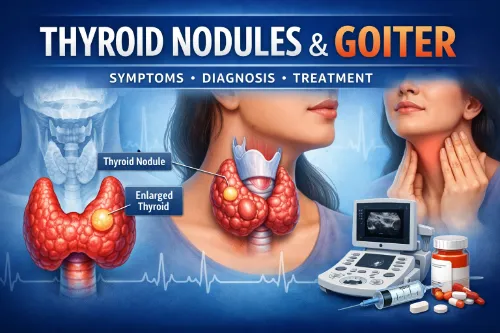
Thyroid nodules and goiter are very common thyroid conditions, and most are non‑cancerous and manageable with monitoring or simple treatment. A thyroid nodule is a lump in the thyroid, while a goiter is an overall enlargement of the thyroid gland.
This guide offers a clear overview; you can also read our main page Thyroid Nodules & Goiter alongside trusted resources from the American Thyroid Association, Cleveland Clinic, Mayo Clinic, and NIDDK/NIH.
What Are Thyroid Nodules?
A thyroid nodule is an abnormal growth of thyroid tissue or a fluid‑filled cyst forming a lump inside the thyroid, which sits at the front of the neck. Nodules can be solid, fluid‑filled (cystic), or mixed, and may be single (solitary) or multiple (multinodular).
How common and how serious
Thyroid nodules are very common; up to about half of adults have at least one nodule detectable by ultrasound, especially with increasing age and in women. The vast majority—around 90–95%—are benign (non‑cancerous), and only a small percentage contain thyroid cancer.
Causes and risk factors
Common causes include overgrowth of normal thyroid tissue (adenoma), fluid‑filled thyroid cysts, chronic inflammation such as Hashimoto’s thyroiditis, iodine deficiency, and, less often, thyroid cancer. Risk factors for nodules or cancerous nodules include being female, age 30–50 or older, prior neck radiation, family history of thyroid disease or thyroid cancer, and some autoimmune conditions.
Symptoms (often none)
Most thyroid nodules cause no symptoms and are found “incidentally” on imaging (ultrasound, CT, MRI) or during a physical exam. When symptoms occur, they may include a visible or palpable lump in the neck, neck pressure or pain, trouble swallowing or breathing, or hoarseness, especially if the nodule is large.
If a nodule makes too much hormone, it can cause hyperthyroidism (nervousness, weight loss, rapid heartbeat, heat intolerance, sweating). Less often, nodules are associated with low thyroid hormone (hypothyroidism), leading to fatigue, weight gain, cold intolerance, and dry skin.
How doctors evaluate nodules
Evaluation usually starts with:
- Physical neck exam and medical history.
- Blood tests to check thyroid‑stimulating hormone (TSH) and sometimes other thyroid hormones or antibodies.
- Thyroid ultrasound to see size, number, and features that suggest benign vs suspicious nodules.
If a nodule is large or has suspicious features, a fine‑needle aspiration (FNA) biopsy is often done to check for cancer cells. In selected cases, a radioactive iodine uptake scan may help determine if a nodule is “hot” (overactive) or “cold” (non‑functioning).
Treatment options
If the nodule is benign, small, and not causing symptoms, the usual approach is watchful waiting with periodic ultrasound and exams. Treatment is considered when nodules are cancerous, suspicious, growing, overproducing hormone, or causing bothersome symptoms, and may include:
- Surgery (partial or total thyroidectomy) for cancer, large or symptomatic nodules, or some toxic nodules.
- Radioactive iodine therapy for overactive (“toxic”) nodules or toxic multinodular goiter.
- Thyroid hormone pills in selected cases, especially after surgery or if hypothyroidism is present.
Most people with thyroid cancer detected within a nodule do very well with appropriate treatment, and long‑term survival is usually excellent.
Nodules are often found incidentally on ultrasound, CT, or MRI done for other reasons.
What a goiter is
The thyroid is a small, butterfly‑shaped gland at the base of the neck that makes hormones controlling metabolism, heart rate, and body temperature. A goiter simply means this gland is larger than normal; it can be smoothly enlarged (diffuse goiter) or bumpy from one or more nodules (multinodular goiter).
Thyroid function with goiter
A goiter can occur when thyroid hormone levels are normal (euthyroid), low (hypothyroidism), or high (hyperthyroidism). In other words, “goiter” describes size, not function, so blood tests are needed to know how well the gland is working.
Main causes
Worldwide, the leading cause of simple (non‑nodular) goiter is iodine deficiency in the diet. In countries where iodized salt makes iodine deficiency uncommon, the most frequent causes are:
- Autoimmune thyroid disease, such as Hashimoto’s thyroiditis (usually underactive) or Graves’ disease (overactive).
- Nodular thyroid disease, where benign nodules grow and enlarge the gland.
Other contributors include thyroiditis (inflammation), certain medicines like lithium, pregnancy‑related hormone changes, and, rarely, thyroid cancer.
Symptoms and complications
Small goiters may cause no symptoms and are often found during routine exams or imaging. Larger goiters can cause:
- Visible neck swelling or a feeling of tightness in the neck.
- Trouble swallowing, breathing, or a chronic cough if the enlarged gland presses on the windpipe or esophagus.
- Hoarseness or voice changes if nearby nerves are affected.
If thyroid hormone levels are abnormal, people may also have symptoms of hyperthyroidism (weight loss, palpitations, heat intolerance, tremor) or hypothyroidism (fatigue, weight gain, cold intolerance, constipation).
How doctors diagnose it
Evaluation usually includes:
- Physical exam of the neck to assess size, shape, and any nodules.
- Blood tests (TSH, free T4, sometimes antibodies) to check thyroid function and for autoimmune disease.
- Thyroid ultrasound to measure the gland, look for nodules, and assess their features.
If nodules look suspicious or are large, a fine‑needle aspiration (FNA) biopsy may be done to rule out cancer. In some cases, CT/MRI or a radioactive iodine uptake scan is used when there is concern about pressure on nearby structures or to clarify function.
Treatment options
Treatment depends on the cause, size, symptoms, and thyroid hormone levels. Common approaches include:
- No immediate treatment (watchful waiting) for small, asymptomatic goiters with normal labs, with periodic exams and ultrasound.
- Thyroid hormone replacement (levothyroxine) if the goiter is due to hypothyroidism.
- Antithyroid medications, radioactive iodine, or other therapies if the goiter is associated with hyperthyroidism (for example, Graves’ disease or toxic multinodular goiter).
- Surgery (thyroidectomy) if the goiter is very large, causing compression symptoms, cosmetically unacceptable, or if cancer is suspected or confirmed.
Most goiters are benign and manageable, especially when the underlying cause is identified and treated.
Common Causes of Thyroid Nodules and Goiter
Thyroid nodules and goiter share many causes.
Frequent causes include:
- Iodine deficiency – still a leading cause of goiter in many parts of the world.
- Autoimmune thyroid disease – Hashimoto’s thyroiditis and Graves’ disease can both be associated with thyroid enlargement and nodules.
- Multinodular goiter – long‑standing growth of multiple nodules, often in older adults.
- Thyroid cysts and benign adenomas – non‑cancerous growths within the gland.
- Thyroid cancer – less common, but important to rule out when evaluating nodules or goiter.
- Pregnancy and hormonal changes – can sometimes enlarge the thyroid or highlight existing nodules.
Many people with nodules or goiter have normal thyroid function tests (euthyroid), but some have hypo‑ or hyperthyroidism depending on the underlying cause.
Symptoms: When Nodules and Goiter Cause Problems
Many nodules and small goiters cause no symptoms and are found during routine exams or imaging. Symptoms are more likely when nodules are large, overactive, or suspicious.
Possible symptoms:
- A visible or palpable lump in the front of the neck.
- A sense of fullness, tightness, or pressure in the neck.
- Difficulty swallowing or feeling that food “catches” in the throat.
- Difficulty breathing, especially when lying flat, if the goiter is very large or extends behind the breastbone.
- Hoarseness or voice changes, especially if a nodule presses on the voice nerve.
- Symptoms of hyper‑ or hypothyroidism if the underlying condition affects hormone levels (for example, “hot” nodules causing hyperthyroidism).
Red‑flag features such as rapid growth, pain, firm or fixed nodules, or associated lymph node swelling need urgent evaluation.
How Nodules and Goiter Are Evaluated
Evaluation aims to answer three main questions:
- Is thyroid function normal? 2) Is there a risk of cancer? 3) Is the goiter or nodule causing pressure or cosmetic problems?
Typical steps:
- History and physical exam – including how long the lump has been present, changes in size, family history, and symptoms.
- Thyroid function tests (TSH, sometimes free T4/T3) – to see if the thyroid is overactive, underactive, or normal.
- Thyroid ultrasound – key imaging test to look at nodule size, number, and features (solid or cystic, margins, calcifications, blood flow).
- Fine‑needle aspiration (FNA) biopsy – recommended for certain nodules based on size and ultrasound features to check for cancer cells.
- Radioactive iodine uptake scans – sometimes used if TSH is low to see if a nodule is “hot” (overactive) or “cold” (non‑functioning).
ATA‑informed practice and StatPearls reviews highlight ultrasound plus TSH as the starting point for most nodules.
Are Nodules and Goiters Always Serious?
In many cases, no immediate treatment is needed.
Examples where watchful waiting may be appropriate:
- Small, benign‑appearing nodules with low‑risk features.
- Tiny incidental nodules (<1 cm) with no suspicious ultrasound features or risk factors.
- Small goiters that are not growing and do not cause symptoms, with normal thyroid function.
In these situations, periodic follow‑up with ultrasound and clinical exams is often recommended.
Treatment Options for Thyroid Nodules & Goiter
Treatment is individualized and depends on the cause, size, symptoms, thyroid function, and cancer risk.
Common approaches:
Observation (“Watchful Waiting”)
If nodules or goiter are small, benign on biopsy, and not causing symptoms, your doctor may simply monitor them.
- Regular check‑ups and repeat ultrasounds at agreed intervals.
- New or rapid growth, symptom changes, or new suspicious features may trigger re‑evaluation or repeat biopsy.
Medication
Medication can help in several situations:
- Thyroid hormone replacement if hypothyroidism is present (for example, in Hashimoto’s disease), which may prevent further enlargement.
- Antithyroid drugs if “hot” nodules or goiter are causing hyperthyroidism.
- Iodine supplementation in regions with iodine deficiency, under medical supervision.
Routine high‑dose thyroid hormone solely to shrink nodules is less common now due to mixed benefit and side‑effect risks.
Radioactive Iodine
Radioactive iodine can be used to:
- Shrink overactive nodules or multinodular goiter, especially when hyperthyroidism is present.
- Reduce the size of some goiters over time when surgery is not suitable.
It is not usually used for obviously benign, non‑functioning small nodules that are not causing trouble.
Surgery
Surgery may be recommended if:
- A nodule is suspicious or confirmed to be cancerous.
- The goiter is very large, growing, or causing significant pressure symptoms or cosmetic concerns.
- Nodules cause persistent hyperthyroidism and other treatments are not suitable or preferred.
Depending on the situation, part or all of the thyroid may be removed, and thyroid hormone replacement may be needed afterward.
Pro Tip for Daily Living with Thyroid Nodules & Goiter
- Ask your specialist to clearly explain your nodule or goiter type (for example, “benign 1.2 cm solid nodule” or “multinodular goiter with normal thyroid function”) and keep that wording in your phone or medical notes.
- If your plan is “watchful waiting,” note the date of your next ultrasound and what change (for example, “>20% growth”) would trigger an earlier review.
- Take photos of your neck (front and side) every few months under similar lighting; this can help you and your doctor notice any gradual change in size.
- If you suddenly notice rapid swelling, new pain, new hoarseness, or trouble breathing or swallowing, seek urgent medical attention rather than waiting for your next routine visit.
Frequently Asked Questions (FAQ)
1. Are most thyroid nodules cancer?
No. The majority of thyroid nodules are benign; only a small percentage contain cancer, and most thyroid cancers are slow‑growing and highly treatable when diagnosed early.
2. If my nodule is benign, do I still need follow‑up?
Yes, most benign nodules are monitored with periodic exams and ultrasounds to watch for growth or changes, though many never cause problems.
3. Can a goiter go away on its own?
Some small goiters, especially those related to transient thyroiditis or mild iodine imbalance, may shrink or stabilize over time, but others remain or slowly enlarge and need monitoring.
4. Do all goiters or nodules need surgery?
No. Many can be safely observed or treated with medication or radioactive iodine; surgery is reserved for specific situations such as suspected cancer, major pressure symptoms, or large cosmetic impact.
5. Can thyroid nodules cause hyperthyroidism or hypothyroidism?
Yes. “Hot” nodules can overproduce hormone and cause hyperthyroidism, while nodules or goiter linked to Hashimoto’s thyroiditis can be associated with hypothyroidism.
6. What tests will I likely need for a thyroid nodule?
Most people need thyroid function tests (TSH), a thyroid ultrasound, and sometimes fine‑needle aspiration (FNA) biopsy, depending on nodule size and appearance.
7. Should my family members be checked if I have nodules?
Routine screening is not always required, but a strong family history of thyroid cancer or certain genetic syndromes may prompt closer evaluation in relatives; ask your doctor what is appropriate for your family.
Disclaimer: This information is for educational purposes only and does not replace medical advice, diagnosis, or treatment from your own healthcare provider.
Written by: Eden Grace Ramos-Arsenio, RN
Sources: American Thyroid Association (ATA); Cleveland Clinic; Mayo Clinic; StatPearls (NCBI/NIH); NIDDK; Hormones Australia; ThyCa; Patient.info; peer‑reviewed medical and nursing journals.