
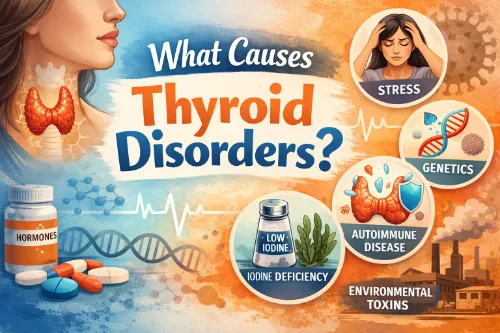
Thyroid disorders usually develop from a combination of factors rather than a single cause. They can be grouped broadly into autoimmune, genetic, hormonal/life‑stage, nutritional, medication‑related, and environmental causes, as described in overviews from organizations such as the National Institute of Diabetes and Digestive and Kidney Diseases (NIDDK), Mayo Clinic, and the American Thyroid Association (ATA).
For a full context, see your main guide Thyroid Problems Explained: Symptoms, Causes, Diagnosis, Treatment & Living Well and this page: What Causes Thyroid Disorders?.
What causes thyroid disorders?
Thyroid disorders happen when the thyroid gland, a small butterfly-shaped gland in the neck, produces too much or too little thyroid hormone. These hormones control metabolism, heart rate, body temperature, and energy levels. When something disrupts this balance, thyroid problems can develop.
Here are the most common causes:
Autoimmune diseases
This is the leading cause worldwide. In autoimmune conditions, the immune system mistakenly attacks the thyroid.
- Graves’ disease causes hyperthyroidism (overactive thyroid).
- Hashimoto’s thyroiditis causes hypothyroidism (underactive thyroid).
These are more common in women and often run in families.
Iodine imbalance
Iodine is essential for making thyroid hormones.
- Too little iodine can lead to goiter and hypothyroidism.
- Too much iodine may also trigger thyroid dysfunction, especially in people who are already at risk.
In the Philippines, iodized salt programs have reduced severe deficiency, but mild imbalances can still occur depending on diet.
Genetics
If you have a family history of thyroid disease or other autoimmune disorders, your risk is higher. Genetics doesn’t guarantee you’ll develop a disorder, but it increases susceptibility.
Thyroid inflammation (thyroiditis)
Inflammation of the thyroid can cause temporary hyperthyroidism followed by hypothyroidism. This may happen:
- After pregnancy (postpartum thyroiditis)
- After a viral infection
- Due to autoimmune activity
Medications and medical treatments
Certain drugs can affect thyroid function, such as:
- Amiodarone
- Lithium
- Interferon
Radiation therapy to the neck area can also damage the thyroid.
Thyroid nodules or tumors
Lumps in the thyroid may produce excess hormones or interfere with normal function. Most nodules are benign, but some may require further evaluation.
Environmental factors
Exposure to radiation, smoking, and certain environmental toxins may increase the risk of thyroid dysfunction, particularly in genetically predisposed individuals.
Hormonal changes
Women are more likely to develop thyroid disorders, especially during:
- Pregnancy
- Postpartum period
- Perimenopause and menopause
In short, thyroid disorders are usually caused by a combination of immune system problems, genetics, iodine imbalance, medications, and environmental triggers. If you’re experiencing symptoms like unexplained weight changes, fatigue, hair thinning, palpitations, or neck swelling, a simple blood test (TSH, T3, T4) can help determine if your thyroid is functioning properly.
Autoimmune Diseases
Autoimmune thyroid disease is the most common cause of long‑term thyroid disorders in iodine‑sufficient countries.NIDDK
- In Hashimoto’s thyroiditis, the immune system attacks and gradually damages the thyroid, often leading to permanent hypothyroidism (underactive thyroid).
- In Graves’ disease, antibodies stimulate the thyroid to grow and produce excess hormone, causing hyperthyroidism (overactive thyroid), and sometimes eye and skin changes.ATA – Hypothyroidism, ATA – Hyperthyroidism
- Autoimmune thyroid disease is more common in women, often runs in families, and is more likely in people with other autoimmune conditions (such as type 1 diabetes, celiac disease, rheumatoid arthritis, or lupus).Office on Women’s Health
Related articles on your site:
- Hypothyroidism (Underactive Thyroid)
- Hyperthyroidism (Overactive Thyroid)
- Thyroid Symptoms in Women
- Thyroid Symptoms in Men
Genetics and Family History
Genetics influence how likely someone is to develop a thyroid problem.NCI
- Thyroid disorders often cluster in families, especially autoimmune conditions and some types of thyroid cancer.
- Certain rare syndromes (for example, familial medullary thyroid carcinoma, multiple endocrine neoplasia) carry a strong inherited risk of specific thyroid cancers.Canadian Cancer Society
- Having a close relative with thyroid disease does not guarantee you will develop it, but it does raise your lifetime risk.
Useful external resources:
- Canadian Cancer Society: What is thyroid cancer?
- NCI: Thyroid Cancer—Patient Version
Related internal guides:
Pregnancy, Postpartum, and Hormonal Changes
Life stages that involve major hormone shifts can trigger or unmask thyroid disease.Endocrine Society
- Pregnancy increases the body’s need for thyroid hormone. Pre‑existing thyroid disease can worsen, and new disease can appear during pregnancy.
- Postpartum thyroiditis can cause a temporary overactive thyroid phase followed by an underactive phase and, in some women, a return to normal.NIDDK – Thyroid Disease & Pregnancy
- Perimenopause and menopause share symptoms with thyroid disorders (hot flashes, sleep and mood changes, weight shifts), which can make thyroid problems harder to recognize.North American Menopause Society
Good external references:
- Endocrine Society: Thyroid Disease and Pregnancy
- Office on Women’s Health: Thyroid disease
Related internal articles:
Iodine Imbalance and Other Nutritional Factors
Iodine is an essential building block of thyroid hormones, and both too little and too much iodine can cause problems.
- Iodine deficiency remains a major cause of goiter and hypothyroidism in many regions without routine iodised salt.Healthdirect
- Excess iodine (from supplements, contrast dyes, or certain medications) can trigger hyperthyroidism or hypothyroidism in susceptible people.NIDDK – Hypothyroidism
- Other nutrients, such as selenium and iron, support normal thyroid hormone production and conversion; severe deficiencies can contribute to dysfunction but are less common causes on their own.
External resources:
- NIDDK: Hypothyroidism
- Healthdirect Australia: Thyroid problems
Internal article:
Medications and Medical Treatments
Several medications and treatments can directly affect the thyroid.Mayo Clinic – Hypothyroidism Causes
Common examples include:
- Amiodarone – a heart rhythm drug rich in iodine that can cause either hypothyroidism or hyperthyroidism.
- Lithium – used for bipolar disorder, it can reduce thyroid hormone release and lead to hypothyroidism.
- Some immune‑modulating and cancer therapies (for example, interferons, tyrosine kinase inhibitors, immune checkpoint inhibitors) can trigger thyroiditis and long‑term thyroid disease.MedlinePlus – Hypothyroidism
- Radioactive iodine therapy and thyroid surgery used to treat hyperthyroidism or nodules/cancer often lead to a predictably underactive thyroid that then requires lifelong hormone replacement.MedlinePlus – Hyperthyroidism
External references:
- Mayo Clinic: Hypothyroidism – Symptoms & causes
- MedlinePlus: Hypothyroidism, Hyperthyroidism
Internal detail:
Radiation Exposure and Environmental Factors
Radiation can damage thyroid tissue and increase the risk of thyroid disease and cancer.NCI – Thyroid Cancer
- Radiation therapy to the head or neck (especially in childhood) can increase the risk of both hypothyroidism and thyroid cancer later in life.
- Environmental or accidental radiation exposure (for example, nuclear accidents) has been linked to higher rates of thyroid cancer in exposed populations, particularly children.StatPearls – Thyroid Cancer
Some environmental chemicals (for example, certain pesticides, industrial compounds) are being studied as potential endocrine disruptors, but their exact role in everyday thyroid disease is still being clarified.
External resources:
- NCI: Thyroid Cancer—Patient Version
- NCBI/StatPearls: Thyroid Cancer
Internal links:
Thyroid Structure Problems: Nodules, Goiter, and Cancer
Sometimes the “cause” of a thyroid disorder is an underlying structural problem, even when hormone levels are normal at first.
- Thyroid nodules (lumps in the gland) are very common; most are benign, but some produce excess hormone (“hot” nodules) or contain cancer.ATA – Thyroid Nodules
- Goiter is an enlarged thyroid, which may result from iodine deficiency, autoimmune disease, multinodular growth, or genetic and environmental factors.ATA – Goiter
- Thyroid cancer arises when thyroid cells grow and divide in an uncontrolled way; most types are highly treatable, especially when found early.Mayo – Thyroid Cancer
These structural problems can lead to overactive, underactive, or normal thyroid function, depending on the underlying process.
External resources:
- ATA: Thyroid Nodules, Goiter
- Mayo Clinic: Thyroid nodules, Goiter
Internal articles:
Other Health Conditions and Risk Factors
Other health conditions and personal factors can increase the likelihood of developing both temporary and long‑term thyroid problems. Below is an expanded, reader‑friendly version of your list.
These conditions are strongly associated with autoimmune thyroid disease (like Hashimoto’s or Graves’):
- Type 1 diabetes (autoimmune destruction of the pancreas).
- Celiac disease (gluten‑triggered autoimmune inflammation of the gut).
- Vitiligo (autoimmune loss of skin pigment cells).
- Pernicious anaemia (autoimmune attack on stomach cells that make intrinsic factor, leading to B12 deficiency).
- Other autoimmune diseases such as lupus, rheumatoid arthritis, Sjögren’s syndrome, and primary adrenal insufficiency (Addison’s).
Having one autoimmune condition means the immune system is more likely to mistakenly attack other organs, including the thyroid.
Age and sex
- Older age: Risk of hypothyroidism and nodular (lumpy) thyroid disease rises with age, especially after about 60.
- Sex assigned at birth: People assigned female at birth are about 5–8 times more likely than those assigned male at birth to be diagnosed with many thyroid disorders, especially autoimmune ones.
Hormonal and immune system differences are thought to explain much of this sex‑related risk.
Major illness, infection, and thyroiditis
A significant illness or infection can trigger temporary inflammation of the thyroid gland, called thyroiditis.
- Subacute (de Quervain) thyroiditis often follows a viral upper respiratory infection and causes neck pain, tenderness, and a short phase of overactive thyroid, often followed by a low‑thyroid phase.
- Acute infectious thyroiditis is rarer and usually caused by bacteria; it can happen during severe systemic infection.
- Post‑viral and post‑COVID‑19 thyroiditis have been reported, where thyroid dysfunction appears weeks after recovery from the infection.
These forms of thyroiditis often improve over weeks to months, but some people are left with permanent hypothyroidism.
Other important risk factors
Several additional factors can also make thyroid problems more likely:
- Family history of thyroid disease (genetic susceptibility).
- Previous thyroid surgery or radioactive iodine treatment.
- Radiation to the neck or upper chest (for cancers like lymphoma).
- Certain medications, such as amiodarone and lithium, which can affect thyroid hormone production.
- High or low iodine intake, depending on the region and diet (iodine is essential for thyroid hormone synthesis).
- Pregnancy and the months after birth, which can trigger postpartum thyroiditis in some individuals.
Related internal guides:
Pro Tip for Daily Living
Thyroid issues often develop quietly over time, but a few simple habits can make your routine visits much more informative and personalized.
1. Keep key history written down
If you have a family history of thyroid disease, other autoimmune conditions (such as type 1 diabetes, celiac disease, rheumatoid arthritis, or lupus), or past radiation to the head and neck, keep a short note with:
- Who was affected (for example, “mother – hypothyroidism,” “sister – Graves’ disease”).
- Any known diagnoses (thyroid, autoimmune, cancers, major neck treatments).
- Approximate dates or ages when these problems started.
Bring this note to routine check‑ups. It helps your clinician understand your baseline risk and decide whether thyroid testing or closer monitoring is appropriate, even if you feel well.
2. Ask about thyroid effects when starting new long‑term medicines
Many long‑term medications can subtly influence thyroid function, including:
- Certain heart rhythm drugs.
- Mood stabilisers and some psychiatric medications.
- Cancer treatments and immune‑modulating or biologic therapies.
When a new long‑term medicine is prescribed, ask:
- “Can this medication affect my thyroid?”
- “Do I need any baseline or follow‑up thyroid blood tests while I am on it?”
This shows you’re proactive and helps the prescriber plan any needed monitoring from the start, rather than waiting for symptoms to appear.
3. Keep perspective when reading about causes online
It’s easy to come across content that blames thyroid problems on one “cause” like a specific food, stress event, or lifestyle habit. In real life, most thyroid disorders arise from several factors combined—such as genetics, autoimmunity, life events, aging, infections, medical treatments, and overall health. This means:
- You did not “cause” your thyroid condition by a single mistake in diet or lifestyle.
- Focusing on blame is less helpful than focusing on understanding your risk factors, staying on top of testing, and following a treatment and follow‑up plan that fits your situation.
Disclaimer: This information is for educational purposes only and does not replace medical advice, diagnosis, or treatment from your own healthcare provider.
Written by: Eden Grace Ramos-Arsenio, RN
Sources: National Institute of Diabetes and Digestive and Kidney Diseases (NIDDK/NIH); Mayo Clinic; NHS; American Thyroid Association (ATA); Cleveland Clinic; Endocrine Society; Thyroid UK; MedlinePlus; peer‑reviewed medical and nursing journals.